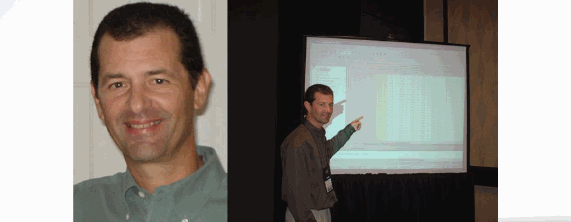
Mark R. Blackburn, Ph.D.

MarkBlackburn_combined.jpg

Dr. Blackburn has more than twenty five years of software systems engineering experience in development, management and applied research of process, methods and tools. He is currently involved in consulting, applied research, training, strategic planning, proposal and business development, as well as developing and applying methods and tools to software and system engineering. He spends most of his time helping companies adopt model-driven engineering tools and methods. He is a frequent speaker at conferences and symposia, and has authored more than 100 papers covering a broad spectrum of topics such as modeling, requirements engineering, verification, software safety, security, reliability, and measurement.
 
It is not the strongest of a species that survives, nor is it the fittest; it is those that can adapt the fastest.” [Darwin]

Experience:

Dr. Blackburn is a Fellow at the Systems and Software Consortium (SSCI). He works with members on a wide variety of software and system engineering topics. His current efforts are focused on helping members improve software systems engineering by understanding how to adopt model driven engineering (MDE) methods, tools, and practices. He is developing guidelines called Integrated Engineering though Models that includes modeling adoption practices and relates to a survey on modeling tools. Other recent efforts include research into academic and industry trends such as Advanced Computing Architectures, Cyber-Physical Systems, autonomous, adaptive, self-managing systems, as well as domain specific languages, the use of Bayesian nets for modeling software reliability, model-based verification of web services underlying service oriented architectures, and development of guidelines for safety-based software assurance for an SSCI member. He has developed and frequently delivers webinars and multi-day training courses related to MDE.

Dr. Blackburn is creator and lead of the model-based test automation framework project (TAF). The TAF integrates with T-VEC tools for requirement and design-based modeling, modeling checking, requirement management, and test automation tools. He used the TAF tools to quickly identify the bug that is the likely cause of the Mars Touchdown Lander crash and proved the T-VEC tools could deliver life-critical and mission-critical software without defects. Much of his training and consulting effort has been in support of technology transfer of model-based tools and the associated process tailoring that is required for adoption within large companies. He has actively participated on model-based efforts for aircraft systems, avionics, medical, automotive, telecomm, database, security, information system, smart cards, and other defense system applications.

Dr. Blackburn has been the principal investigator to the National Institute of Standards and Technology on nine continuously running projects dating back to 2000 involving model-based verification of security related products and applications.        

Dr. Blackburn has been involved in applied research and advanced technology demonstrations for architecture for real-time embedded systems, safety-critical software, formal methods approaches to high assurance, requirement specification and model-based verification, model-based verification of security properties, web-based knowledge engineering, domain engineering, reverse engineering of programs to specifications, and object technology.


From 1988 to 1993 he co-developed and applied T-VEC on flight critical, real-time embedded systems that were FAA certified.

From 1983-1988 he was involved in the graphics processor development of a flight critical electronic flight instrumentation system that was also FAA certified.

From 1979 to 1982 he was involved in applied research and development of a formal specification-based methodology and associated tool system.

Education:

Ph.D. Information Technology, George Mason University,
M.S. Mathematics (emphasis in C.S.), Florida Atlantic University, and
B.S. Mathematics (C.S. option), Minor in EE, Arizona State University.

SSCI Reports,
Courses,
Papers:

Bayesian Networks – A New Class of Management Tools for Prediction, Estimation and Risk Management

Advanced Computing Architecture Trends
 
Business and Technology Trends: 2010
 
Bayesian Belief Network Approach to Software Reliability
 
Defining Requirements and Design for Safety Critical Software Systems
 
Process Workflow and Application Lifecycle Management Tool Survey
 
What's Model Driven. Engineering (MDE) and How Can it Impact. Process, People, Tools and Productivity?
 
MDE Series: System-Level Modeling of Customer-Needed Capabilities
 
MDE Series: Leveraging System-Level Models
 
MDE Series: Modeling Tool Survey

Model Driven Engineering for High Dependability Systems Course

The Engineering of Model-Based Testing: Guidelines and Case Studies

Requirements-Based Verification Sign-Off for Subcontract Integration Compliance

Objective Measures for V&V and Software Reliability

Risks and Mitigation Strategies for Using Automatic Code Generation Tools

Strategies for Web and GUI Testing

Guidelines for Software Tool Qualification

Applying the Test Automation Framework With Use Cases and the Unified Modeling Language

Guidelines for Using Test Automation Framework Measures

Model-Based Verification and Validation for Security Requirements of Systems

Guidance for Achieving Mission Assurance in Software-Intensive Systems

Component Assessment Using Specification-Based Analysis and Testing

Model-Based Development and Automated Testing Course

Test Automation Framework for T-VEC and Simulink Course

Testing Complex Systems Course

Public Papers,
Presentations:

Model-Driven Verification and Validation, Safe & Secure Systems & Software Symposium, June 2010

Evolving Systems Engineering through Model Driven Functional Analysis, NDIA, October 2009.

Requirement Modeling for the C-5 Modernization, CrossTalk, 2009.

Life Cycle Integration of Model-Based Testing Tools, DASC, 2005.

Using Models for Development and Verification of High Integrity Systems, INCOSE, 2004.

Using Model-Based Testing to Assess Smart Card Interoperability Conformance, CCCT, 2004.

Objective Measures from Model-Based Testing, STAREAST, 2004.

Interface-Driven, Model-Based Test Automation, CrossTalk, 2003.

Model-based Approach to Security Test Automation, ISSRE, 2002.

Mars Polar Lander Fault Identification Using Model-based Testing, NASA Software Engineering Workshop, 2001.

Events:

Webinar: Bayesian Networks A New Class of Management Tools for Prediction, Estimation and Risk Management

Which Way Up - Growth in a Changed Economy?, MIT Enterprise Forum of South Florida

Webinar: Model Driven Engineering (MDE) - System-Level Modeling of Customer-Needed Capabilities

Webinar: Model Driven Engineering (MDE) - Leveraging System-Level Models

Webinar: Model Driven Engineering (MDE) - Modeling Tool Survey

Webinar: Model Driven Engineering (MDE) - Tool Chains for Simulink

Webinar: Model Driven Engineering (MDE) Modeling Adoption Practices

Webinar: Integrated Engineering through Models

Webinar: Advanced Computing Architecture Trends

Webinar: What's Model Driven Engineering (MDE) and Why Should I Care?

Webinar: How does Model Driven Engineering (MDE) Impact My Process?

Webinar: What's Happening with Model Driven Engineering (MDE) Tools?

Webinar: What's Next to Come with Model Driven Engineering (MDE)?

Webinar: Framework for Quantifying Vertical and Horizontal Derived Requirements

CEO Roundtable View from the Hot Seat in a Cool Economy CEO Insights for Weathering the Economic Storm, MIT Enterprise Forum of South Florida

Technical Exchange: Strategies Leading To Successful Integration and Test

Email: blackburn at software dot org
 
©  2008-2010 Mark R. Blackburn, Ph.D.